
Which fingers go numb tells you more than almost any test does. That single detail separates three conditions that get confused constantly, and it is the first thing Draper Spinal Care asks about when someone arrives convinced they have carpal tunnel syndrome. A surprising number of people show up already wearing a wrist brace that has not helped, because the nerve is being pinched somewhere other than the wrist.
Sorting this out matters, since each problem is treated differently and a brace aimed at the wrong location wastes six weeks.
What does the pattern of numbness tell you?
Each condition follows the territory of a specific nerve or nerve root, and the borders are reasonably predictable.
- Carpal tunnel syndrome affects the thumb, index, middle, and the thumb side of the ring finger. The little finger is spared, and the palm is often spared too, because the nerve branch supplying it splits off before entering the tunnel
- Cervical radiculopathy follows the root involved. C6 sends symptoms into the thumb and index finger, C7 into the middle finger, and C8 into the ring and little fingers
- Neurogenic thoracic outlet syndrome most often affects the little finger, the ring finger, and the inner forearm, since the lower part of the brachial plexus sits most exposed
Little finger numbness is the cleanest rule of thumb. The median nerve does not supply it, so if that finger is involved, carpal tunnel is not the whole story.
How do you know if it is actually carpal tunnel syndrome?
Carpal tunnel syndrome is compression of the median nerve where it passes under the transverse carpal ligament at the wrist, and its signature is night symptoms that wake you and ease when you shake the hand out. Roughly 3 to 6 percent of adults are affected.
The nighttime pattern happens because most people sleep with the wrist flexed, which raises pressure inside the tunnel. Clinical tests include Phalen’s maneuver, Tinel’s sign, and the carpal compression test, none definitive alone. Nerve conduction studies confirm the diagnosis and grade severity.
The American Academy of Orthopaedic Surgeons clinical practice guideline supports night splinting in a neutral wrist position as a first-line option, typically trialed for at least six weeks before escalating. Thenar muscle wasting, meaning visible loss of the fleshy pad at the base of the thumb, signals advanced compression and warrants surgical consultation rather than continued conservative care.
When is the neck the real source?
Suspect the cervical spine when symptoms change with head position, when neck or shoulder blade pain accompanies the hand symptoms, or when resting your hand on top of your head brings relief. That last finding is called the shoulder abduction relief sign and it is fairly specific to nerve root compression.
Cervical radiculopathy occurs when a nerve root is irritated as it exits the spine, usually from disc material or arthritic narrowing. A population study by Radhakrishnan and colleagues in Rochester, Minnesota found an annual incidence of about 85 per 100,000, with C7 the most commonly involved root followed by C6. Spurling’s test, which extends and rotates the neck toward the symptomatic side with gentle downward pressure, has high specificity but misses many cases, so a negative result does not clear the neck.
A person can also have compression at two sites at once, sometimes called a double crush. Someone with an irritated C6 root and a tight carpal tunnel may get only partial relief from addressing either alone.
What makes thoracic outlet syndrome different?
Thoracic outlet syndrome involves compression of the brachial plexus or the vessels beneath it as they pass between the scalene muscles, over the first rib, and under the collarbone. The giveaway is that symptoms appear with the arms elevated, during tasks like drying hair, reaching into an overhead cabinet, or holding a steering wheel.
The neurogenic form accounts for roughly 90 to 95 percent of cases. A cervical rib, an extra rib above the first, is present in well under 1 percent of the population and is one contributing factor among several, with scalene tightness and posture more common. The elevated arm stress test, holding the arms up and opening and closing the hands for three minutes, tends to reproduce symptoms.
Sudden swelling, heaviness, or bluish discoloration of the arm points to the venous form and needs prompt medical evaluation rather than conservative care.
What does an evaluation at Draper Spinal Care involve?
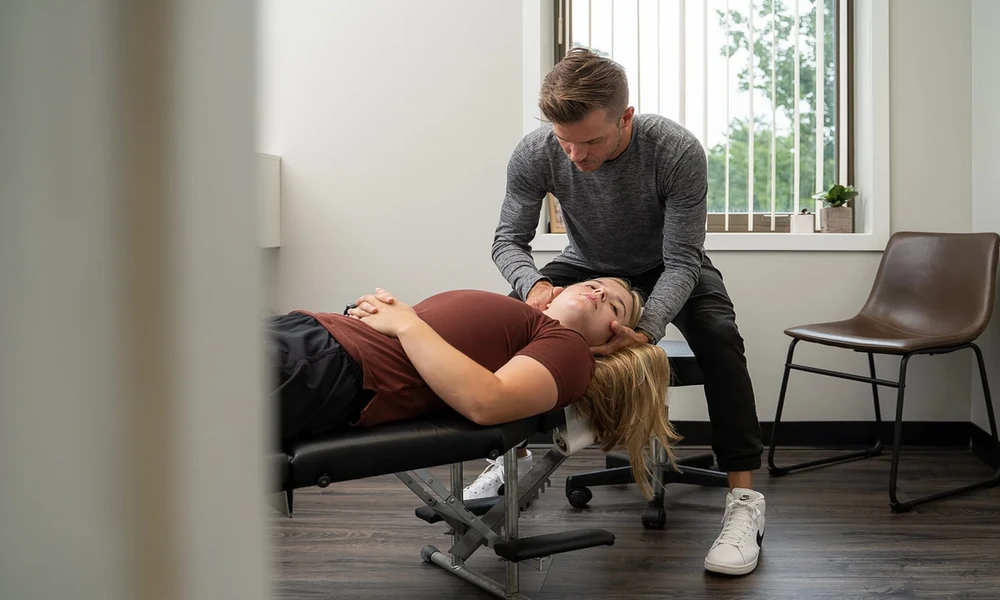
The exam works from the pattern backward: mapping the exact distribution of symptoms, checking cervical range of motion and joint function, testing reflexes and grip strength, then running provocation tests at the neck, the thoracic outlet, and the wrist to see which reproduces the complaint.
Upper cervical care can help when altered mechanics in the neck are contributing to nerve irritation or to the muscle guarding that narrows the thoracic outlet. It is not the answer to everything on this list. True median nerve entrapment at the wrist, particularly with weakness or muscle wasting, belongs with a hand specialist, and an honest evaluation says so rather than starting a treatment plan that was never going to work.
Certain findings need urgent attention regardless: numbness in both hands together with clumsiness, changes in walking or balance, or any bowel or bladder change can indicate spinal cord involvement.
Numbness that has persisted more than a few weeks deserves a proper differential rather than a guess and a drugstore brace. If your symptoms include the little finger, shift with neck position, or appear whenever your arms go overhead, the wrist is probably not the culprit, and an exam at Draper Spinal Care can identify which level is actually involved before you commit to treating the wrong one.

Comments are closed.