
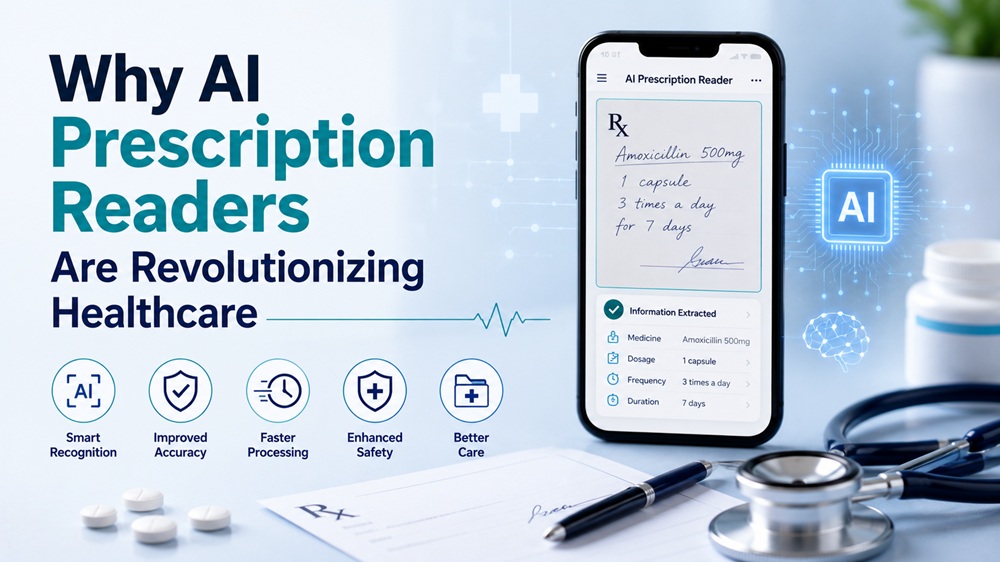
A doctor scribbles a quick note on a paper pad. A pharmacist stares at the page, trying to read the messy handwriting and decipher the precise dosage. This moment plays out thousands of times every day in clinics and medical stores. When a mistake occurs at this step, the outcomes can be serious for the patients. Artificial Intelligence (AI) prescription readers offer a fix for this age-old problem. These smart tools interpret printed and handwritten notes with high precision and translate them into digital records. This change does more than just save time. It develops a safer system where mistakes are caught early, and care happens faster.
What Is an AI Prescription Reader?
AI prescription reader is an AI-based application that uses OCR to recognize prescription information in images or documents.
It can retrieve the following information, such as:
- Name of medicines
- Dosages
- Strength of prescriptions
- Use frequency
- Treatment period
- Doctors’ handwritten notes
Most AI tools retrieve prescription information within seconds.
Why AI Prescription Readers Are Transforming Healthcare
AI is widely used in healthcare to increase precision and reduce the need for human involvement.
Key Advantages
- Rapid medication prescription processing
- Enhanced handwriting recognition
- Decreased instances of medication mistakes
- Enhanced patient safety
- Decreased administrative burden
All these factors contribute to increased efficiency in the healthcare setting.
Key Benefits for Patients and Healthcare Providers
AI prescription readers help improve the experience for everyone involved.
| Benefit | How It Helps |
| Better accuracy | Reduces handwriting-related errors |
| Faster service | Speeds up prescription verification |
| Improved safety | Helps identify possible medication errors |
| Digital records | Simplifies documentation |
| Better communication | Makes prescriptions easier to understand |
These improvements support safer medication management.
Speeding Up Diagnosis and Treatment Plans
Time is often the most limited resource in healthcare. AI tools help by taking the burden of manual work off medical staff. When a patient visits a clinic, the doctor needs to act fast. For example, Medipedia’s AI prescription reader allows clinicians to move quickly from a check-up to a treatment plan without getting stuck in paperwork.
Extracting Patient Data Quickly
AI programs scan prescriptions and pull out key details in seconds. The software identifies the patient name, the drug name, the dosage, and how often it should be taken. By doing this, the system removes the need for manual typing. When a human types in these details, they might hit the wrong key or misread a number. AI reduces these errors significantly.
Building Accurate Medication Histories
Patients often see multiple doctors and specialists. Keeping a complete list of their current medications is hard. AI readers connect to Electronic Health Records (EHRs) to automatically build this list. The system reviews the new prescription against what the patient is already taking. If the software spots a potential conflict, it alerts the doctor right away.
Helping With Clinical Decisions
Doctors rely on their training and experience to choose treatments. However, keeping up with every new study or drug guidelines is impossible for any individual. AI adds another layer of support. By analyzing a prescription against a patient’s health profile, the AI can suggest alternatives. It might flag that a patient has a kidney condition that makes a certain drug unsafe. The doctor then receives a notification to consider an alternative.
Where AI Prescription Readers Are Used
Various healthcare organizations are adopting these tools.
Common Applications
- Hospitals
- Clinics
- Community pharmacies
- Telemedicine programs
- Electronic health records systems
- Applications for patients’ health
Prescription management through digital channels is growing rapidly in healthcare.
The Future of AI in Medication Management
The current technology is just the beginning. We are witnessing a shift where AI will become a standard part of every physician’s office and pharmacy. As these smart tools grow, they will solve even more problems.
Better Text Recognition
Handwriting is notoriously difficult for computers to read. However, AI is getting better at it every day. Soon, these systems will interpret the most confusing notes with total accuracy. They will handle non-standard formats and complex abbreviations that usually require a human to decode.
Predicting Future Needs
AI could look at a patient’s health record and predict what they might need next. If a patient is starting a long-term treatment, the system could suggest a follow-up schedule. It could even predict when a refill is due and alert the patient to prevent a gap in their care.
Final Thoughts
AI prescription readers are changing healthcare for the better. They eliminate errors caused by handwriting and manual entry, making medication safer. They save time for physicians and pharmacists, allowing them to focus on what matters: the patient. By turning prescriptions into clear, actionable data, these smart tools help spot public health trends and improve drug development. This is not a trend for the future. It is a change occuring today. Adopting this technology is a smart move for any healthcare professional who wants to offer safer, faster, and more effective care.

Comments are closed.