
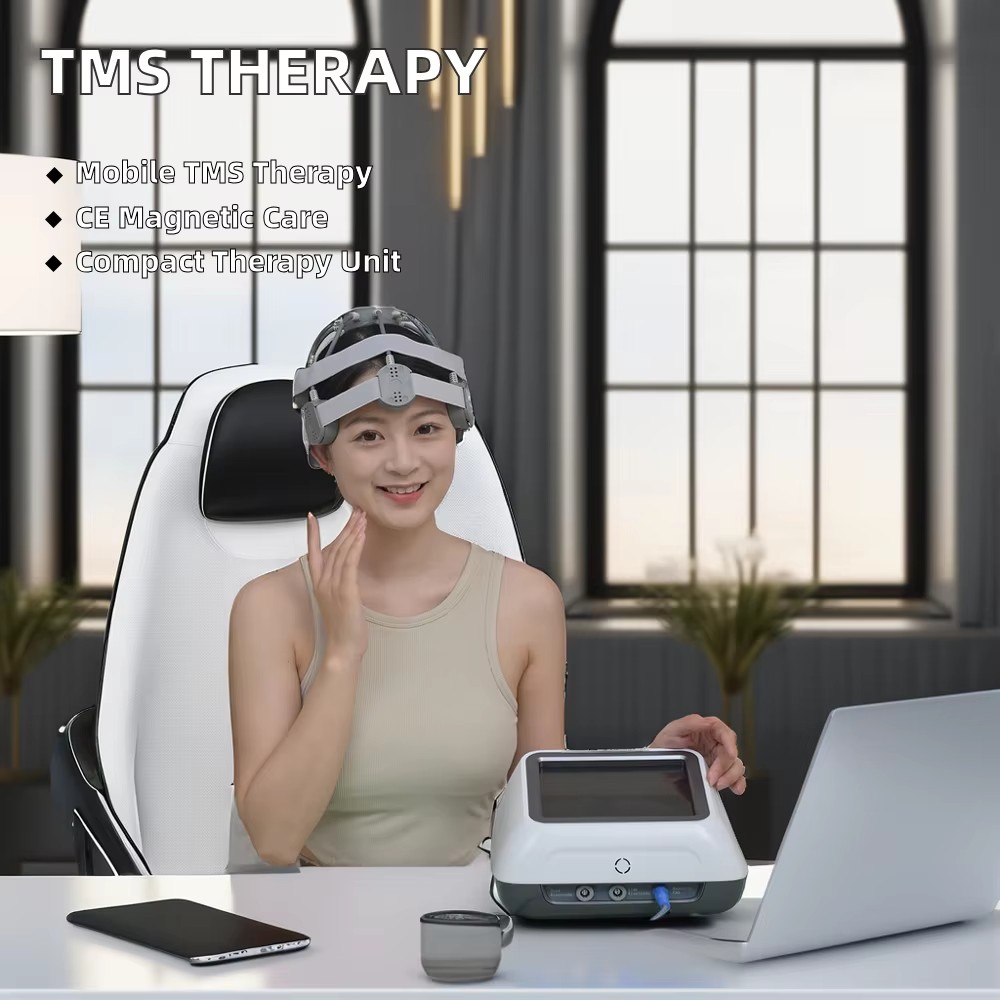
Millions of people worldwide suffer from neurological and psychiatric conditions that disrupt daily life—from post-stroke motor impairment to debilitating migraines and obsessive-compulsive disorder (OCD). Traditional treatments often come with side effects or invasive risks, leaving patients desperate for safer alternatives. Today, Transcranial Magnetic Stimulation (TMS) emerges as a game-changer, and QIJIA’s weak magnetic non-invasive TMS device redefines accessible, gentle neurotherapy for diverse conditions. TMS therapy for depression treatment
Core Technology & Working Principle: Gentle Magnetic Precision
QIJIA’s TMS device is built on the core principle of electromagnetic induction, a scientifically validated mechanism for non-invasive brain modulation. Unlike high-intensity magnetic stimulation, its weak magnetic design delivers mild, focused magnetic pulses that penetrate the skull without attenuation or tissue damage <superscript>1. These pulses induce tiny electrical currents in targeted cerebral cortex regions, regulating neuronal excitability and rebalancing disrupted neural circuits—all without surgery, needles, or systemic medications.
The key advantage of QIJIA’s weak magnetic technology lies in its dual capability: high-frequency pulses (>1Hz) to activate underperforming brain areas, and low-frequency pulses (≤1Hz) to inhibit overactive regions <superscript>4. This precise modulation promotes neuroplasticity, the brain’s natural ability to reorganize and heal—laying the foundation for effective treatment of various neurological and psychiatric conditions.
Simple & Comfortable Treatment Process
QIJIA’s TMS device is designed for user-friendliness, suitable for clinical settings and home use (under professional guidance). The treatment process is streamlined and painless, typically lasting 20-30 minutes per session:
- Pre-Treatment Evaluation: A healthcare provider assesses the patient’s condition, reviews imaging results (e.g., MRI), and determines the target brain region and stimulation parameters <superscript>3.
- Precision Targeting: The ergonomic magnetic coil is placed on the scalp, aligned with the targeted area (e.g., motor cortex for stroke recovery, prefrontal cortex for OCD).
- Gentle Stimulation: The device delivers controlled weak magnetic pulses. Patients may feel a slight tapping sensation but no pain or discomfort.
- Course Planning: A standard course involves 5 sessions per week for 4-6 weeks, with personalized adjustments based on treatment response. No anesthesia or post-treatment recovery time is needed.
Targeted Applications: Who Benefits Most?
QIJIA’s weak magnetic TMS device addresses unmet needs across multiple patient groups, with proven efficacy in key areas:
- TMS device for stroke recovery: For patients with upper limb hemiparesis or motor function impairment post-stroke, the device targets the contralesional motor cortex to enhance motor evoked potentials and improve manual dexterity <superscript>5. It accelerates rehabilitation by reactivating dormant neural pathways.
- TMS therapy for OCD: By modulating the overactive prefrontal cortex circuits linked to obsessive thoughts and compulsive behaviors, the therapy reduces symptom severity. It offers a safe alternative for patients unresponsive to medication or cognitive-behavioral therapy.
- TMS therapy for migraine: Single-pulse stimulation disrupts cortical spreading depression—the underlying mechanism of migraine aura—providing acute relief. Repetitive stimulation also helps prevent recurrent migraines by stabilizing brain excitability<superscript>2.
- Other Applicable Groups: The device is also suitable for patients with mild cognitive impairment, post-traumatic stress disorder (PTSD), and chronic neuropathic pain, as well as elderly and pediatric patients (with adjusted parameters) due to its gentle non-invasive design.
Why Choose QIJIA Weak Magnetic TMS Device?
QIJIA’s TMS device stands out in neurotherapy with patient-centric advantages:
- Weak Magnetic & Non-Invasive: Eliminates risks of invasive procedures (e.g., surgery) and side effects of systemic drugs, ensuring long-term treatment safety.
- Clinically Validated Efficacy: Proven results in TMS therapy for migraine, OCD, and stroke recovery, with consistent neuroregulation outcomes.
- Portable & Convenient: Lightweight design and rechargeable battery support home-based treatment, reducing hospital visit frequency and improving compliance.
- User-Friendly Operation: Intuitive digital panel with preset modes for common conditions simplifies parameter adjustment, accessible to both healthcare providers and patients.
Living with neurological or psychiatric conditions shouldn’t mean compromising on quality of life. QIJIA’s weak magnetic Transcranial Magnetic Stimulation device combines advanced neuroregulation technology with gentle non-invasive design, making effective therapy accessible and comfortable. Whether as a TMS device for stroke recovery, a solution for OCD, or a relief for migraine sufferers, it empowers patients to take control of their health and caregivers to provide reliable support.
Discover QIJIA’s innovation in neurotherapy—where gentle magnetic pulses unlock the brain’s natural healing power.

Comments are closed.